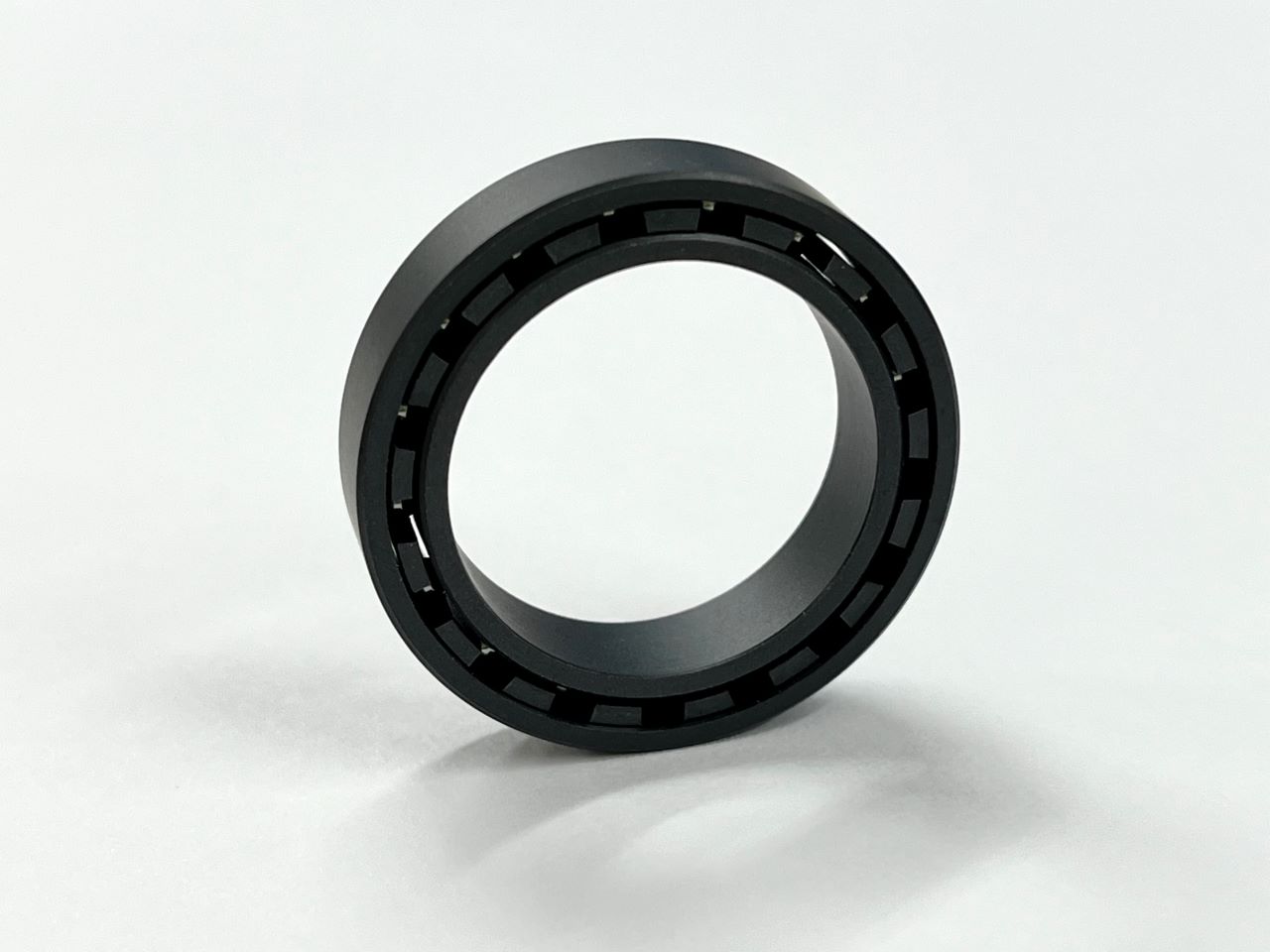
Our bearings were used as test components for electrostatic motor parts.
Although electrical insulation is generally required in such applications, there was a specific request to allow electrostatic charges to be partially dissipated from the shaft to the outer ring, while also reducing weight. Based on this requirement, we were asked whether it would be possible to manufacture the bearing from a conductive plastic material.
As the requested dimensions were not a standard size, the bearing was manufactured according to the customer’s specified dimensions.
Since we manufacture our bearings using machining processes, we often use rod or pipe stock as raw materials. Therefore, even when electrical conductivity is required—as in this case—it is possible to produce a finished bearing from a suitable conductive-grade plastic material, provided that such a material is available.
However, it should be noted that plastic remains plastic, and sufficient electrical conductivity may not always be achieved. Depending on the material, the volume resistivity can vary widely, typically in the range of 10² to 10⁴. In addition, variations may occur depending on material composition and component geometry. For this reason, we recommend consulting our sales department in advance when considering use in such applications.
Related Pages