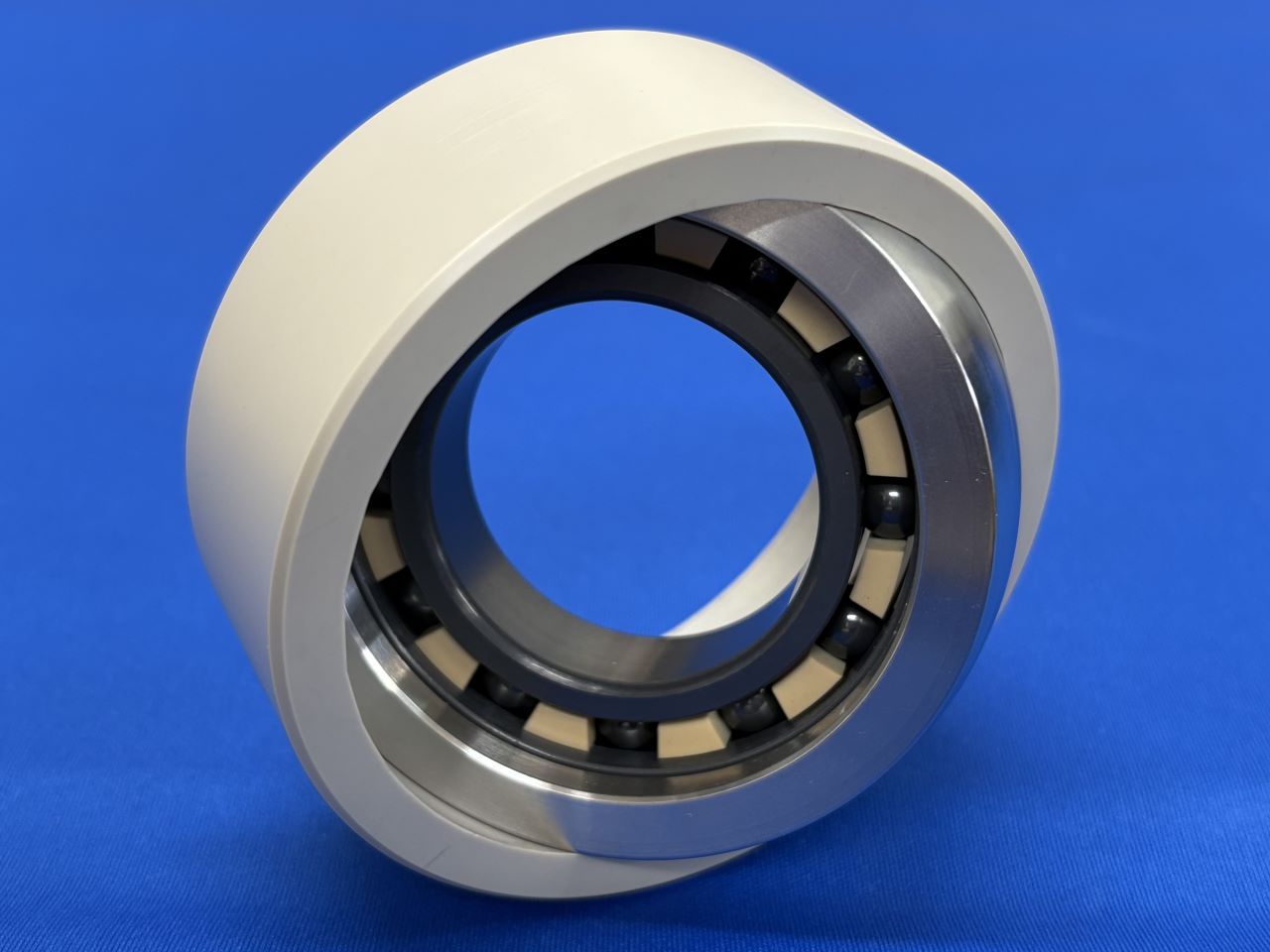
For use in chemical liquids or environments (Caustic Soda, Sulfuric Acid, Boric Acid / Special Shapes / Special Combinations) exposed to chemicals, we typically supply bearings in which the race rings and cage are made of plastic, while the balls are made of ceramic.
In such environments, plastic bearings—ranging from standard sizes to special shapes—can generally be used without issue. In this article, however, we introduce a self-aligning bearing with a special geometry and a special material combination.
Plastic self-aligning ball bearings have a significantly lower load capacity compared with metal self-aligning ball bearings. Therefore, when higher loads are involved, a common question is whether the bearing can be manufactured entirely from ceramic or titanium.
Regarding ceramic bearings, we offer two types: one manufactured entirely in Japan in our own production facilities, and another supplied as an overseas OEM product. However, the ceramic ball bearings manufactured by us are currently limited in available production sizes, making it impossible to manufacture larger dimensions. The overseas OEM products, while available in a wider range of sizes, suffer from quality variability and do not allow the issuance of various certificates.
As for titanium, there are no issues with size availability, quality, or certification, and it is also manufactured entirely in Japan. However, cost is a significant disadvantage.
Because the bearing shown has a special size and shape, manufacturing it entirely from ceramic or titanium would result in extremely high costs. For this reason, we proposed a combined material design. This approach made it possible to reduce costs while achieving a higher load capacity than that of an all-plastic bearing.
In the example shown, SUS304 stainless steel is partially used. In this case, SUS304 was compatible with the chemicals involved; however, depending on the type of chemical, titanium may be used for these components instead.
We offer a wide range of self-aligning bearings that can be used in chemically aggressive environments without concern for corrosion and without the need for lubrication.
Related Pages